
Septoria tritici or Septoria nodorum
Scientific Name:
Scientific Name:
Crops:
Crops:
- Common wheat
- Durum wheat
- Wheat
- Cereals (durum and soft wheat)
- Grain
Biology
Control Method
Biology
-
Definition
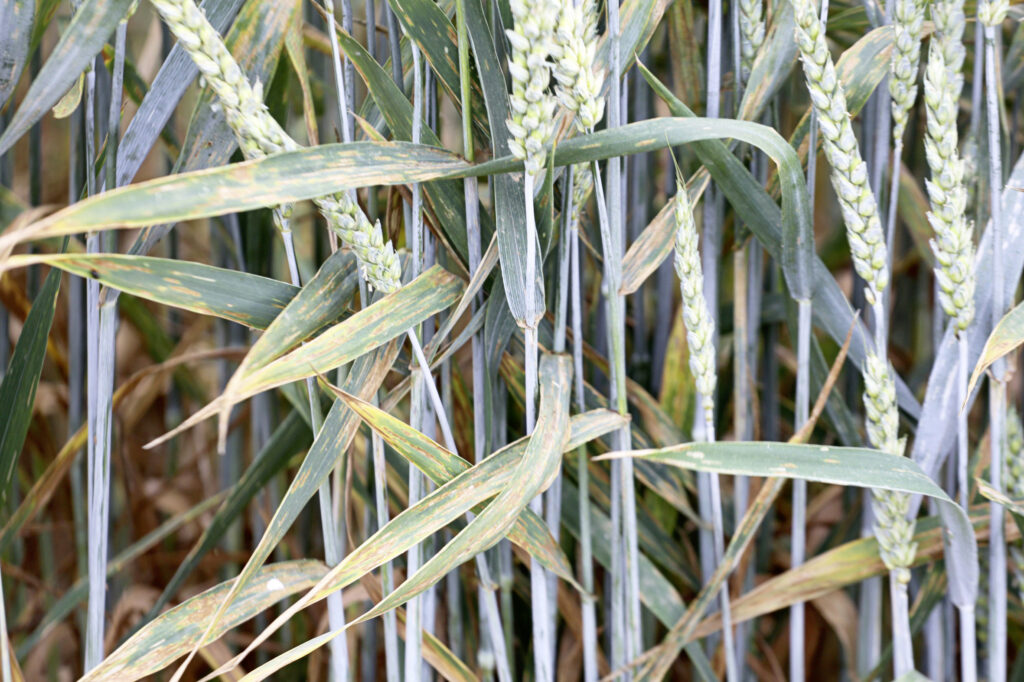
Foliar disease of wheat that can appear as early as the seedling stage. Symptoms are often first seen in the leaves at the base. This disease can cause large yield losses when the flag leaf and the last two leaves are infected during flowering (which will cause the grain to scald).
Development Lifecycle
In the autumn, primary contaminations occur. The ascospores and pycnidospores formed on the straw residues will be carried by the winds and find a home on the young wheat shoots and begin their development.
In winter, progress is slowed down by unfavourable weather conditions.
In the spring, milder temperatures will reactivate the epidemic. Symptoms appear and the pycnidia will ensure the spread of the disease by “splashing” effect (projection of spores by raindrops) from the lower leaf levels to the upper levels, but also to neighbouring plants.
The risk period for contamination is from the 2-node stage to the flowering stage.
Symptoms
- Seen more frequently in winter in early spring.
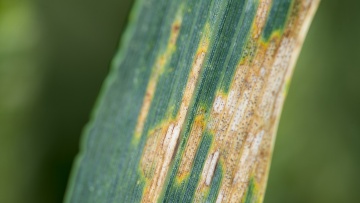
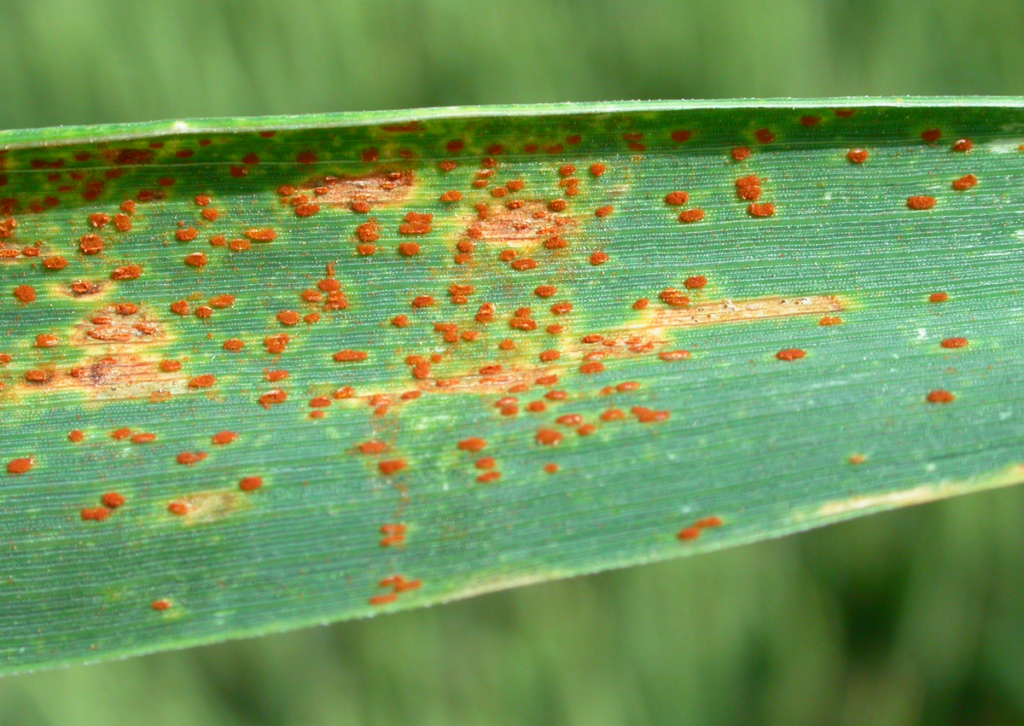
- Oval, brownish spots with small black dots (pycnidia) that appear at the beginning of the formation of necrosis. (or several days after necrosis in the case of S. nodorom). These spots are often irregular and remain localized in places such as the edges of the blade or the interveinal spaces.
- Very often, the spots begin with a palling of the blade which retains a greenish colour impregnated with brown.
- After the appearance of the small black dots, the pycnidia (blackheads) exude a transparent colourless jelly in the form of twists: the cirrhae. On the other hand, S. nodorum secretes bright pink cirrhes.
Contributing factors
- It occurs mainly on susceptible varieties during mild winters and wet and windy springs.
- Temperatures of 12 to 20°C favour the appearance of the disease. Contamination is inhibited if the minimum temperature is below 7°C for two consecutive nights.
- Relative humidities of 90 to 100% from 3 p.m. to 4 p.m. are a factor for successful contamination.
- Splashing rainfall 10-15 mm (main factor in vertical and lateral dissemination).
- A 35-hour wetting period of the leaves followed by a period of relative humidity above 80% for 45 hours is enough to have contamination.
Control Method
Chemical method
- The symptoms of necrosis of septoria are not yet visible on wheat leaves. However, it is at this time, during the incubation phase, that we need to treat.
- The objective of the fungicide program is to protect the leaf levels that condition yield development: mainly F1 and F2 and, to a lesser extent, F3.
- If the risk of septoria is significant, a fungicide program must target the protection of F3 in the first pass, at the 2-node stage. If the risk is lower, it should target the protection of the last two leaf levels F2 and F1, ideally at the last dotting leaf or last spreading leaf stage.
- The threshold for intervention is 20%. It is recommended to treat the plot if 20% of the leaves are affected, i.e. 4 out of 20 leaves. Above this threshold, damage can negatively affect yield.
- In all cases, other diseases must be taken into consideration in the choice of products. The fight against septoria can be coupled with protection of the ear if necessary.


