
Cycloconium oleaginum
Scientific Name:
Scientific Name:
Crops:
Crops:
Olive tree
Biology
Control Method
Biology
-
Definition
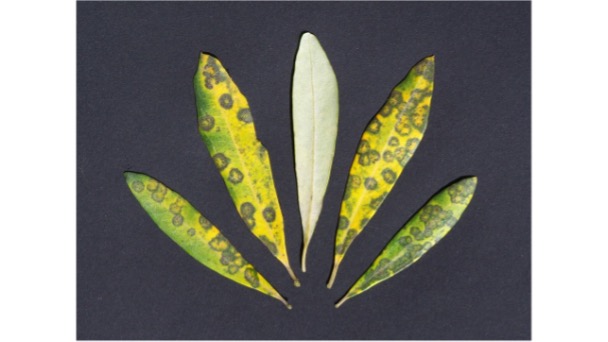
Olive scab, also known as peacock’s eye, is a fungal disease that mainly affects the leaves of the olive tree, causing them to fall prematurely and, in severe cases, to lose vigour and yield. Under favorable conditions, the fungus can also infect the fruit, causing it to fall off.
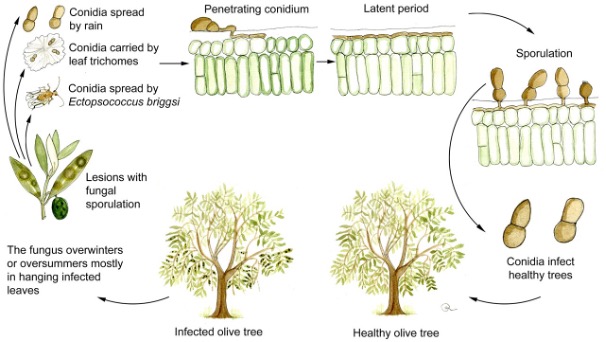
Development Lifecycle
-
-
Contamination : Fungal spores (conidia) germinate on moist leaves, usually after periods of rain or high humidity.
-
Infection : The fungus enters through the stomata and grows inside the leaf tissue.
-
Symptoms visible about 15 to 30 days after infection.
-
Spread : Conidia disperse via wind or splashing water.
-
Critical periods : autumn and spring, when conditions are cool and wet.
Generations per year :
-
Saïss region : 2 to 3 generations/year (often autumn)
-
Haouz region : up to 4 generations/year (2 in autumn, 2 on late varieties)
-
Symptoms
-
-
-
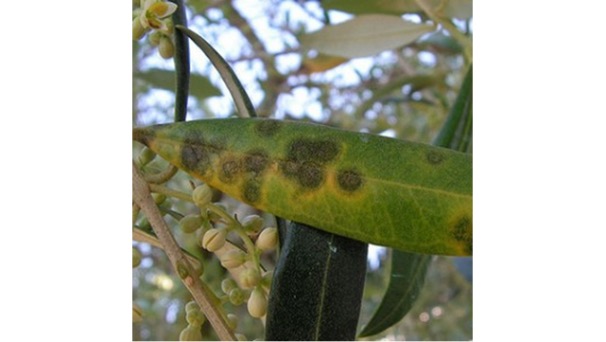
Small round spots (6 to 10 mm) on the leaves, with:
-
Centre brown to greyish
-
Dark, regular border
-
-
Appearance reminiscent of a peacock’s eye, hence the common name.
-
Both sides of the leaves can be affected.
-
Significant leaf drop, causing the tree to weaken.
-
In the event of a severe attack: fruits affected at the level of the peduncle, causing their premature drop.
-
-
Contributing factors
-
-
-
Mild and humid climate (temperatures between 12 and 22 °C).
-
Autumn and spring rains.
-
Poorly aerated orchard, dense foliage, close plantings.
-
Weakened or unpruned trees.
-
-
-
Control Method
Preventive control
- Annual pruning to aerate the canopy and promote ventilation.
- Avoid sprinkler irrigation during sensitive periods .
- Regular monitoring and removal of severely affected leaves.
- Choice of varieties that are more tolerant to the disease.
Chemical control
-
Application of copper fungicides (Bordeaux mixture, copper oxychloride), by:
- Autumn (before the first rains)
- Spring (after pruning)
- Repeated treatments if favourable conditions persist.
Biological control
- Ongoing research on the use of antagonistic fungi and beneficial bacteria.


